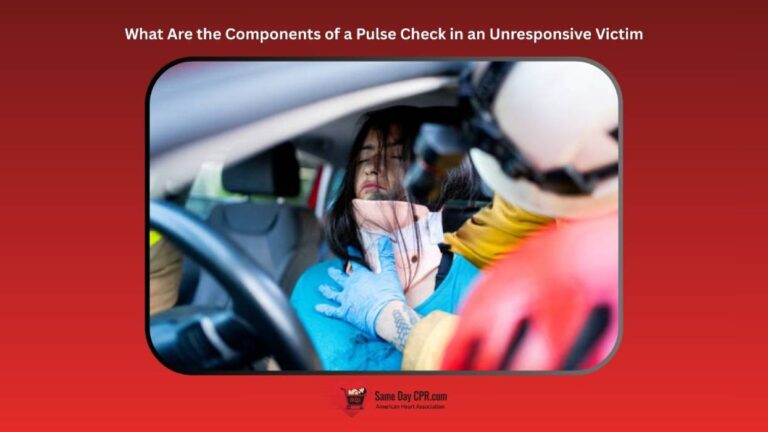
The main components of a pulse check in an unresponsive victim are identifying the correct pulse point, checking for a pulse for no more than 10 seconds, and determining whether a definite pulse is present. For an adult, a trained responder typically checks the carotid pulse while assessing breathing and responsiveness. If no definite pulse is detected, CPR (Cardiopulmonary Resuscitation) should be started according to current resuscitation guidelines.
Understanding these key components helps you perform a pulse check quickly and accurately and take the appropriate next step in an emergency.
When Should You Check for a Pulse?
A pulse assessment may be part of the evaluation when a person/ victim is unresponsive and is not breathing normally or is only gasping.
For a trained healthcare professional, checking for a pulse can help determine whether cardiac arrest is present. The assessment should be performed quickly and should take no more than 10 seconds.
For an untrained bystander, attempting to find a pulse should not delay CPR. If an adult is unresponsive and not breathing normally or is only gasping, the bystander should activate the emergency response system and begin CPR according to current resuscitation guidance.
The priority is to recognize a possible cardiac arrest and begin lifesaving care as quickly as possible.
What Should a Bystander Do if Someone Is Unresponsive?
A bystander should focus on recognizing the signs of cardiac arrest and taking immediate action rather than spending time trying to locate a pulse.
- Recognize Abnormal Breathing or Gasping: If the person is unresponsive and is not breathing normally or is only gasping, treat the situation as a possible cardiac arrest.
- Activate the Emergency Response System: Call the local emergency medical service or have someone nearby make the call. If an automated external defibrillator (AED) is available, ask someone to bring it immediately.
- Start CPR: Begin CPR with chest compressions as soon as possible when cardiac arrest is suspected. Follow instructions from the emergency dispatcher if available.
- Use an AED When Available: Apply and use an AED as soon as it is available. Follow the device’s voice or visual instructions and continue CPR as directed.
How Do Trained Responders Check a Pulse?
The following pulse assessment technique is intended for trained healthcare professionals and other responders who are trained to assess a pulse during an emergency. Identifying the correct pulse point for the person’s age is an important part of performing a quick and effective pulse check.
Carotid Pulse in Adults and Children
- For adults and children, a trained responder can assess the carotid pulse on one side of the neck.
- Place the index and middle fingers in the groove between the trachea and the sternocleidomastoid muscle. Apply gentle pressure and assess for a definite pulse.
- Do not press both sides of the neck at the same time.
Brachial Pulse in Infants
- For infants, a trained healthcare professional assesses the brachial pulse on the inside of the upper arm, between the shoulder and elbow.
- Use gentle pressure and assess the pulse promptly rather than spending excessive time trying to locate it. See pulse check method for infants for more details.
Use the Correct Finger Placement
- Use the index and middle fingers to assess the pulse. Avoid using the thumb because it has its own pulse, which can interfere with the assessment.
Check for No More Than 10 Seconds
- A trained responder should check for a pulse for no more than 10 seconds.
- If a definite pulse cannot be detected within that time, CPR should be started according to the responder’s training and current resuscitation guidelines.
What Should You Do After a Pulse Check?
The appropriate response depends on whether a definite pulse is present and whether the person is breathing normally.
No Definite Pulse: Start CPR
- If a trained responder cannot detect a definite pulse within 10 seconds, begin CPR immediately and activate the emergency response system if this has not already been done.
- Use an AED as soon as one is available.
Pulse Present but No Normal Breathing
- If a trained responder detects a pulse but the person is not breathing normally, provide rescue breathing according to current AHA guidance and the responder’s training.
- Continue monitoring the person’s breathing and pulse and provide appropriate emergency care.
Pulse and Normal Breathing Present
- If the person has a pulse and is breathing normally but remains unresponsive, maintain the airway, monitor the person closely, and follow appropriate first-aid or emergency-care procedures while waiting for help.
- If appropriate, place the person in a recovery position to help maintain an open airway.
Common Pulse-Check Mistakes to Avoid
Knowing what to avoid can make a pulse check faster and more reliable. A few simple habits can help you stay focused and avoid delays when every second matters.
Spending Too Long Looking for a Pulse
A pulse assessment should not delay CPR. A trained responder who cannot confidently identify a pulse within 10 seconds should proceed according to cardiac-arrest protocols.
Using the Thumb
The thumb can have a detectable pulse of its own and may make the assessment confusing. Use the index and middle fingers instead.
Pressing Too Hard
Excessive pressure can make a pulse more difficult to detect. Use gentle, controlled pressure.
Checking Both Sides of the Neck at Once
When assessing the carotid pulse, check one side at a time. Avoid compressing both carotid arteries simultaneously.
Delaying CPR Because of Uncertainty
Do not spend additional time trying to confirm an uncertain pulse. When a trained responder cannot identify a definite pulse within the recommended assessment period, CPR should not be delayed.
For bystanders, attempting to find a pulse should not delay recognition of cardiac arrest, activation of emergency services, or CPR.
Why CPR and BLS Training Matters
CPR and BLS training helps responders recognize cardiac arrest, perform appropriate assessments, begin CPR promptly, and use an AED effectively. For bystanders, CPR training can build confidence in recognizing an emergency and starting lifesaving care without unnecessary delay. For healthcare professionals and other trained responders, BLS (Basic Life Support) training provides additional skills for pulse assessment, ventilation, chest compressions, and AED use.
The most important principle is to avoid delaying lifesaving care while trying to confirm a pulse. When cardiac arrest is suspected, rapid recognition and appropriate CPR can be critical to survival.
Performing a Quick and Accurate Pulse Check in an Emergency
In summary, A pulse check is an important part of assessing an unresponsive person, but it should always be done quickly and carefully. Trained responders should check the correct pulse point for no more than 10 seconds and decide whether a definite pulse is present. If no pulse is detected, CPR should begin without delay, and an AED should be used as soon as it is available. For bystanders, recognizing unresponsiveness and abnormal breathing is more important than trying to find a pulse. Knowing these simple steps can help you stay calm, act quickly, and provide the right care during an emergency.
Ready to build your confidence in an emergency? Enroll in a Same Day CPR blended learning class today and gain practical skills in CPR, BLS, and AED use. Complete your hands-on training and earn your official American Heart Association (AHA) certification with convenient courses at locations near you.