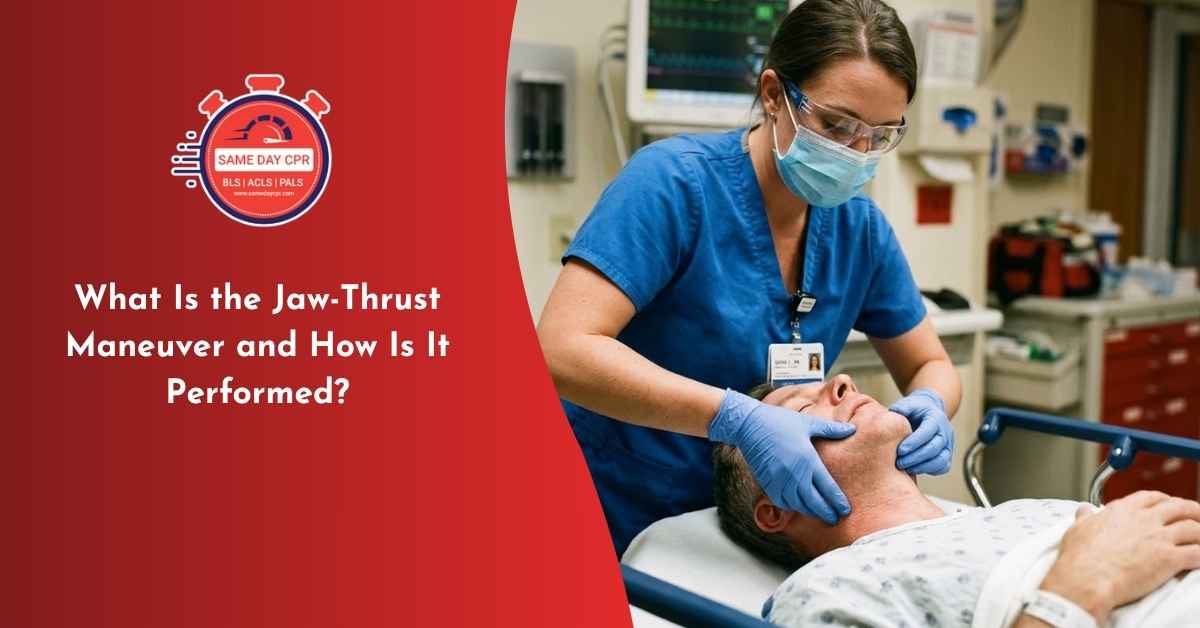
If a person becomes unresponsive, maintaining an open airway is an immediate priority. The jaw-thrust maneuver is an airway-opening technique that moves the lower jaw forward to help prevent the tongue from obstructing the airway.
It is particularly associated with situations in which a head, neck, or spinal injury is suspected, because it can open the airway without deliberately tilting the head backward. The maneuver is primarily a technique for trained rescuers and healthcare professionals.
If an unresponsive person is not breathing normally, do not delay emergency care, CPR, or AED use while attempting to perform an unfamiliar airway technique. Follow local emergency guidance and dispatcher instructions.
What Is the Jaw-Thrust Maneuver?
The jaw-thrust maneuver is an airway-opening technique in which the lower jaw, or mandible, is moved forward while unnecessary movement of the head and neck is avoided.
When a person loses consciousness, the muscles supporting the tongue and upper airway can relax. The tongue may move backward and partially obstruct airflow. Bringing the lower jaw forward can help move the tongue away from the back of the throat and improve the airway.
The jaw-thrust is commonly considered when an unresponsive person may have sustained a cervical spine injury, such as after:
- A serious vehicle collision
- A significant fall
- A diving injury
- A major blow to the head or neck
- A sports-related head or neck injury
Importantly, the jaw-thrust does not guarantee that the neck will remain completely motionless. It is intended to avoid deliberate head extension while opening the airway.
When Is the Jaw-Thrust Maneuver Used?
The jaw-thrust may be considered when a person is unresponsive, needs airway support, and there is concern about a possible head, neck, or spinal injury.
Examples include trauma involving:
- The head or face
- The cervical spine
- A high-impact vehicle crash
- A fall from a significant height
- Diving into shallow water
- A substantial blow to the head or neck
- Symptoms such as weakness, numbness, or severe neck pain after an injury
The technique may also be incorporated into professional airway management and resuscitation.
The jaw-thrust is not automatically the preferred airway-opening technique for every patient. When there is no reason to suspect a spinal injury, trained rescuers commonly use the head tilt and chin lift.
The appropriate technique depends on the person’s condition, the possibility of trauma, and the rescuer’s level of training.
How to Perform the Jaw-Thrust Maneuver
The jaw-thrust requires appropriate training and practical instruction. The following steps provide a general explanation rather than a substitute for formal first-aid, CPR, or healthcare training.
Step 1: Make Sure the Scene Is Safe
Before approaching the person, check for hazards such as traffic, fire, electricity, unstable structures, or falling objects.
Do not put yourself at unnecessary risk while attempting to assist.
Step 2: Check Responsiveness and Breathing
Speak to the person and check whether they respond.
If the person is unresponsive, assess whether they are breathing normally and activate emergency medical services according to local guidance.
If trauma is suspected, avoid unnecessary movement of the person’s head and neck.
Step 3: Position Yourself
A trained rescuer generally works from the person’s head so they can control the jaw while minimizing unnecessary movement of the head and neck.
The precise technique and hand positioning can vary according to the rescuer’s training and clinical protocol.
Step 4: Place Your Hands on the Jaw
Place your fingers along the bony portions of the lower jaw on both sides.
Avoid pressing into the soft tissues beneath the chin or neck. The objective is to control the mandible rather than compress the soft tissue surrounding the airway.
Step 5: Move the Lower Jaw Forward
Gently lift and move the lower jaw forward.
The objective is to bring the mandible forward and help move the tongue away from the back of the throat.
Use only the amount of force necessary to establish the airway. Avoid excessive pressure or unnecessary movement.
Step 6: Reassess the Airway and Breathing
After attempting to open the airway, reassess the person’s breathing.
Look for normal chest movement and signs of effective breathing. Abnormal, irregular, or gasping breaths should not automatically be considered normal breathing.
If the airway remains obstructed or the person is not breathing normally, follow emergency protocols and escalate care as appropriate.
Jaw-Thrust vs. Head Tilt and Chin Lift
Both techniques are designed to help open an obstructed airway, but they differ in how the airway is opened.
| Technique | Basic action | Common consideration |
|---|---|---|
| Jaw-thrust | Moves the lower jaw forward | Often considered when cervical spine injury is suspected |
| Head tilt and chin lift | Tilts the head backward and lifts the chin | Commonly used when spinal injury is not suspected |
The head tilt and chin lift opens the airway by extending the head and lifting the chin, which can move the tongue away from the back of the throat.
The jaw-thrust primarily advances the lower jaw without deliberately extending the head.
When spinal injury is suspected, a trained provider may choose the jaw-thrust while maintaining appropriate spinal precautions. When spinal injury is not suspected, the head tilt and chin lift may be easier and more effective for opening the airway.
Neither technique should be considered universally superior. The person’s condition and the rescuer’s training determine the appropriate approach.
Common Mistakes to Avoid
Several mistakes can make the jaw-thrust less effective or potentially cause harm.
Using Excessive Force
The jaw should be moved deliberately but without unnecessary force. Excessive pressure can cause pain or potentially worsen an injury.
Pressing on Soft Tissue
Avoid pressing deeply into the soft tissues beneath the chin or neck. The maneuver should focus on the bony lower jaw.
Moving the Head and Neck Unnecessarily
If spinal injury is suspected, avoid unnecessary head and neck movement while attempting to establish an airway.
Forgetting to Reassess Breathing
Opening the airway is not the end of the assessment. Continue checking breathing and the person’s overall condition.
Delaying CPR
If an unresponsive person is not breathing normally, do not spend excessive time attempting an airway maneuver when CPR is indicated. Activate emergency medical services, begin CPR according to your training or dispatcher instructions, and use an AED when available.
Assuming the Maneuver Will Always Work
The jaw-thrust cannot resolve every cause of airway obstruction. Blood, vomit, swelling, foreign material, or other airway problems may require additional intervention.
What If the Jaw-Thrust Does Not Open the Airway?
The goal is not simply to perform the jaw-thrust correctly. The goal is to establish and maintain an effective airway and adequate breathing.
If the maneuver does not adequately open the airway, a trained healthcare professional should reassess the patient and use the next appropriate intervention according to the patient’s condition and established clinical protocols.
Additional airway interventions may include:
- Suction
- Airway adjuncts
- Bag-mask ventilation
- Other professional airway-management techniques
A suspected spinal injury should not prevent necessary airway and breathing support. Spinal precautions are important, but maintaining oxygenation and ventilation is also critical.
For an untrained bystander, the safest approach is generally to follow emergency dispatcher instructions rather than repeatedly attempting an unfamiliar airway maneuver.
What Should a Bystander Do?
A bystander does not need advanced medical training to take important action during an emergency.
If you find someone who may be unconscious:
- Make sure the scene is safe.
- Check whether the person responds.
- Check for normal breathing.
- Activate emergency medical services.
- Follow the emergency dispatcher’s instructions.
- If the person is not breathing normally, begin CPR according to your training or dispatcher guidance.
- Use an AED as soon as one is available and follow its voice or visual instructions.
A trained bystander may know how to perform the jaw-thrust, but an untrained person should not delay CPR or other lifesaving measures while trying to perform a technique they have never learned.
The priority is to recognize the emergency, activate help, support breathing and circulation as instructed, and provide appropriate lifesaving care.
Key Takeaways
- The jaw-thrust maneuver is an airway-opening technique that moves the lower jaw forward.
- It can help reduce airway obstruction caused by the tongue.
- It is particularly considered when a head, neck, or spinal injury is suspected.
- Unlike the head tilt and chin lift, it does not deliberately extend the head backward.
- The jaw-thrust does not guarantee complete immobilization of the cervical spine.
- Proper technique requires appropriate training and should be performed according to applicable clinical protocols.
- If the airway remains obstructed, trained providers should use appropriate additional airway-management measures.
- Bystanders should activate emergency medical services and follow dispatcher instructions.
- If a person is unresponsive and not breathing normally, do not delay CPR or AED use while attempting an unfamiliar airway maneuver.
- The ultimate priority is to establish an effective airway and support adequate breathing and circulation.
The Importance of Proper Airway Management
In short, the jaw thrust maneuver can help open the airway when a person is unresponsive, especially when a head, neck, or spinal injury may be present. It moves the lower jaw forward while avoiding deliberate backward movement of the head. However, this technique requires proper training, and it should never delay emergency care, CPR, or AED use. The most important step is to recognize the emergency, call for help, check breathing, and follow trained guidance. With the right approach, rescuers can support the airway while also protecting the person from further harm.
Ready to build confidence and sharpen your lifesaving skills? Choose Same Day CPR’s convenient blended-learning CPR courses in BLS, ACLS, or PALS. Complete the coursework online, then join us in person for hands-on practice and skills training. Train with confidence, practice the right techniques, and be prepared to respond when it matters most.